Pious foundations (waqf) have long been recognized as the most pervasive and powerful social institutions within the Ottoman Empire. Not surprisingly then, their study is of perennial interest to scholars seeking to explore the social, economic, and religious contours of the empire. Even so, few efforts have been made to examine the functioning of these institutions in a comprehensive, systematic manner across the wide temporal and spatial breadth of the empire.
The OTTOWAQF project is undertaking such an effort by analyzing the diachronic and synchronic development of foundations across the Ottoman Empire between the fourteenth and eighteenth centuries. To do so, we are proceeding on two interlocking levels of analysis. On one level, the research team is working collaboratively to analyze the long-term functioning and financial performance of foundations from across the empire that fell under the supervision (nezaret) of high-ranking Ottoman officials beginning the late sixteenth century. On another level, individual members of the research team are developing in-depth studies based upon foundations of individual families and social groups or through the functioning of foundations in particular geographic locations.
The collective work of the project focuses upon the social, economic, and legal aspects of a representative sample of sixty foundations that came under the central supervision (nezaret) of high-ranking Ottoman officials beginning in the late sixteenth century. These sixty waqfs were established between the fourteenth and eighteenth centuries by Ottoman sultans, members of the dynasty, high-ranking officials, mid-level functionaries, and pre-conquest elites in places as far-flung as the banks of the Danube, Tigris, and Nile, provincial cities and towns in the Balkans, Anatolia, and Syria, as well as the imperial centers of Istanbul, Bursa, and Edirne. The core source corpus for our sample consists of the more than forty extant foundation deeds (vakfiye, sing.), and their 1,285 annual accounting registers (muhasebe, sing.) produced between the fifteenth and eighteenth centuries.
Encompassing all the largest foundations in the empire, centrally supervised foundations formed a vital component of the Ottoman sociopolitical order and state-building processes. They not only provided essential public goods and contributed to state finances but also maintained extensive networks of privilege, entitlement, and loyalty—functions that reinforced the legitimacy of the ruling order and the allegiance of ordinary subjects. Both the scale of their activities and the breadth of their social, economic, political, and financial roles distinguished them as a distinct category within the wider landscape of Ottoman foundations.

Centrally supervised foundations were also the best documented foundations within the empire before the establishment of the Ministry of Endowments in the nineteenth century. A systematic review of accounting registers preserved in the Ottoman Archives of the Presidency identified around 400 distinct foundations with at least one surviving register dating between 1575 and 1720. The number and chronological coverage of surviving records, however, vary considerably across these foundations. While some of the largest foundations are represented by dozens of registers throughout the period, only a few survive for smaller ones. Of these approximately 400 foundations with registers preserved in the archive, one-half have three or more.
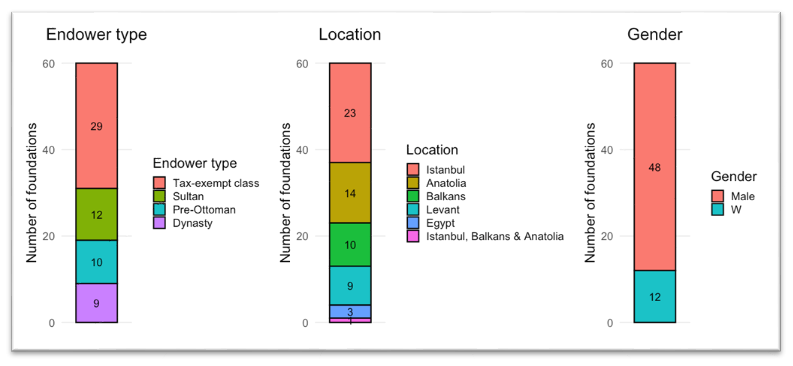
The representative sample of centrally supervised foundations used by OTTOWAQF is constructed to approximate the population of centrally managed waqfs along two dimensions: geographic location and endower type.

In constructing our sample, we first grouped the archival registers by geographic region and endower type and approximated a proportional representation for these two categories in relation to extant archival lists of centrally supervised foundations from the seventeenth century. We assembled a sample of sixty foundations, each with at least ten surviving registers covering the period 1575–1800.
In our sample of 60 waqfs, the largest share—23—were in Istanbul, followed by 14 in Anatolia, 10 in the Balkans, 9 in Syria, Cyprus, and Iraq, and 3 in Egypt. We made similar efforts to distribute the foundations in our sample across endower type (sultanic, 12 foundations; dynastic, 9; per-Ottoman elites, 10; and askeri, 29). This sample provides a substantially high level of coverage of the available archival material. It includes approximately 15 percent of all foundations for which at least one accounting register survives in the Ottoman archives from 1575 to 1700, and about 30 percent of those with three or more registers from this period.
For this sample of 60 waqfs, approximately 3,500 accounting records were examined. While roughly 40% of the records covered a single accounting year the length of accounting periods varied from as little as one month to several years. To ensure comparability over time, only registers covering approximately one full year (12 solar months ± 15 days) were retained. The final panel dataset comprises 1,285 complete registers from 60 foundations, established at various times throughout the study period by a diverse group of founders—from pre-Ottoman figures to members of the Ottoman dynasty and ruling elite—across a wide geographic area.

The accounting data from these records include revenues, expenditures, debts, and accounts receivable, as well as detailed information on the charitable activities, assets, personnel, and market activities of foundations. They therefore offer an exceptionally detailed window into the financial performance of a foundation. When analyzed across centuries and among a range of foundations, they offer unique insights into the relationship of foundations to the Ottoman state and the wider economy.
Alongside these accounting registers, OTTOWAQF seeks to understand the evolving activities of foundations in relation to the stated original intentions of their founders, as reflected in foundation deeds. To do so, we are constructing a second large dataset derived from deeds and addenda (zeyl, sing.) that have been located for more than 40 of the foundations in our sample. In addition to key data regarding the founder and foundation date, analysis of these documents focuses on understanding the charitable purposes, endowed assets, foundation personnel and stipendiaries, and key legal clauses that governed the foundation.


The aim is to produce a unified analytical framework that nonetheless preserves the variation, inconsistencies, and incongruences across the source material. We address this challenge through a source-centered methodology that decomposes each document into its smallest meaningful component while preserving their original legal form, vocabulary, and temporal layers. In other words, we are extracting information at the smallest unit level shared by all the documents we are analyzing. So, with respect to charitable purposes, we not only record the many mosques, colleges, and soup kitchens of the foundations, but also provisions in the deed for religious services, such as daily supplications (dua, sing.), or extraordinary social services, such as provisions for food for the public at feast days. We take a similar approach with respect to recording the personnel and stipendiaries mentioned within the foundation deeds, and as a result have identified more than 80 distinct positions within the documents, ranging from waqf administrators (mütevelli) and college instructors to more modest positions of doorkeepers, custodians, carpet sweepers, lamplighters, and latrine cleaners.
This approach of recording the smallest unit level is also applied to the many endowed assets of each foundation. Not only are we recording the many endowed villages, but also small units such as gardens, shops, houses, and rooms. When doing so, for each unit, we identify a geo-administrative anchor at the smallest identifiable level, ranging from province (vilayet) to individual building. This anchoring is allowing us to create a geographical index at the level of towns or cities and local districts (nahiye, sing.) with the aim of integrating the data into a GIS to enable geographic visualizations.
This approach of recording the smallest unit level is also applied to the many endowed assets of each foundation. Not only are we recording the many endowed villages, but also small units such as gardens, shops, houses, and rooms. When doing so, for each unit, we identify a geo-administrative anchor at the smallest identifiable level, ranging from province (vilayet) to individual building. This anchoring is allowing us to create a geographical index at the level of towns or cities and local districts (nahiye, sing.) with the aim of integrating the data into a GIS to enable geographic visualizations.

In all cases, we are taking care to record the original terminology in Arabic script with precise reference to the source, while standardizing this terminology through a controlled vocabulary. The work of analyzing these sources is proceeding apace. To date, we have identified more than 260 charitable purposes, 1900 assets units, and 1300 specified positions and stipendiaries.
In the coming years, OTTOWAQF aims to integrate the quantitative data of the accounting registers with the qualitative data of the deeds within a shared relational database that will allow us to explore the complex geospatial relationships of foundations, as well as their evolving activities and financial performance.